Disappearing Kinship: How Growing Up Teaches Children to See Animals as ‘Other’
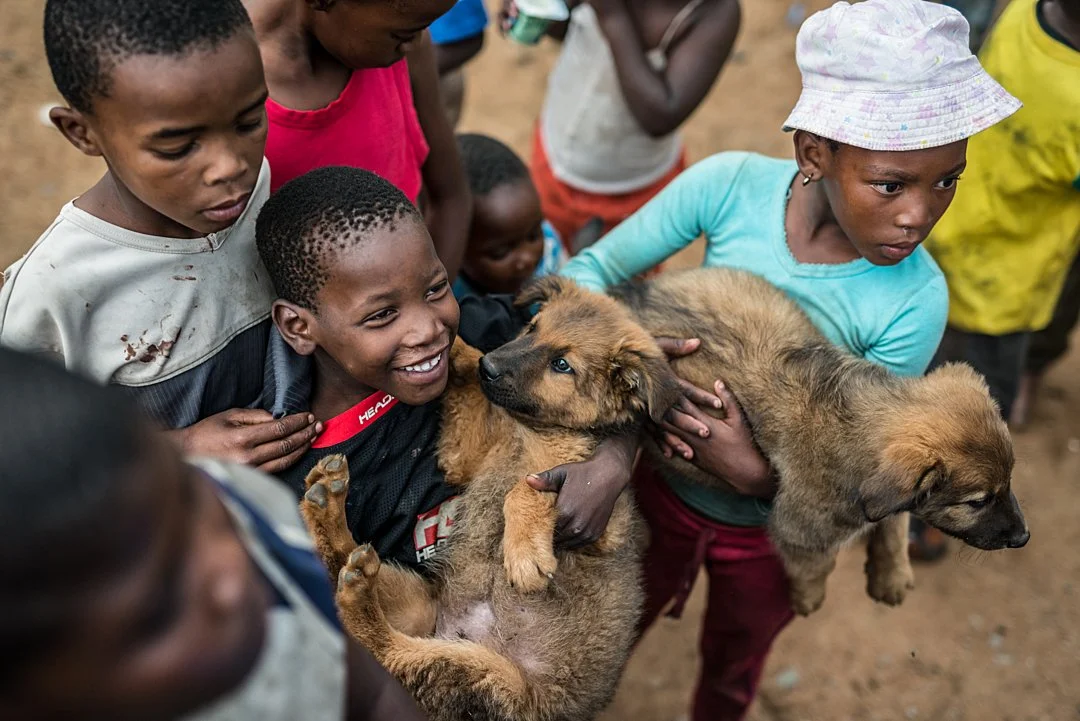
“Studies repeatedly show real benefits to children who share affectionate bonds with animals.” Children at the Randfontein municipal dump bring their dogs to Cora Bailey and John Matumba for health checks. Bailey is the founder of South Africa's Community Led Animal Welfare (CLAW), a project of the International Fund for Animal Welfare (IFAW). South Africa, 2016. Jo-Anne McArthur / #unboundproject / We Animals
In an instagram post, Ayesha Chundrigar, founder of ACF Animal Rescue in Pakistan, walks among children in a poor neighbourhood in Karachi. She is explaining why they don’t need to be afraid of some street dogs, who have taken refuge from the heat in dirty water. “Kids, we have asked you not to throw stones at the dogs,” she says. “You shouldn’t be hitting dogs. Let them stay here. They’re not bothering you, are they?” They meet a puppy, who has been beaten but he’s young so his tail still wags tentatively. Today, he’s lucky. There are over seven million stray dogs in Karachi alone; almost all are regarded as bearers of disease and trouble, for which they are tortured, poisoned and shot. [1]
Loose-limbed and excited, the puppy runs back and forth, from person to person, as if he quite can’t believe this uptick in fortune. “Don’t beat him and don’t run away from him,” says Ayesha, before introducing the children to the puppy’s parents. The father, older and wiser, lounges cautiously beneath a car. Ayesha explains that animals hide when they’re frightened. “You don’t have to be scared,” she says. “They won’t do anything.” It is a masterclass in empathy-buillding; kind but firm, serious in content but clear in tone, with the animals right there, being themselves, small movements explained; terror, for both children and animals, dissipated.
Few would dispute that children are naturally drawn to animals. Humans evolved alongside animals and survival depended on noticing, understanding, and responding to them - but it’s more than that. Animals communicate through body language, which is often easier for children to interpret than the complex social signals of the adult world. And animals can offer quiet companionship. Biophilia, the term popularised by biologist Edward Wilson, suggests humans are innately drawn to other living beings; children often show this strongly, seeking out other species, talking to them, showing curiosity rather than fear, until fear is taught. [2]
While adults have yet to settle on a way of describing our relationship to animals (pets, companions, friends?), for children, it may be closer to kin. When researchers asked children and adults whether they would choose to save the lives of humans over other animals like dogs or pigs, children almost always chose to save animals - even when the choice was between two humans and one dog. [3] And kinship has consequences: in another study, children showed less speciesism, were less likely to categorize farm animals as food, thought that farmed animals ought to be treated better - and thought eating animals and their products to be less morally acceptable. [4] You don’t hurt - or consume - family.
Growing up is hard to do
At some point, this changes - and mapping that change speaks volumes about broader issues of humanity’s accord with nature. Chistine Webb is author of The Arrogant Ape: the myth of human exceptionalism and why it matters. “Many people intuitively think that human exceptionalism is part of our nature, but recent studies in cross-cultural and developmental psychology contradict [that] view.” Instead, studies show that human exceptionalism is culturally dependent and that the perspective that humans are morally special is a “socially acquired ideology.” [5]
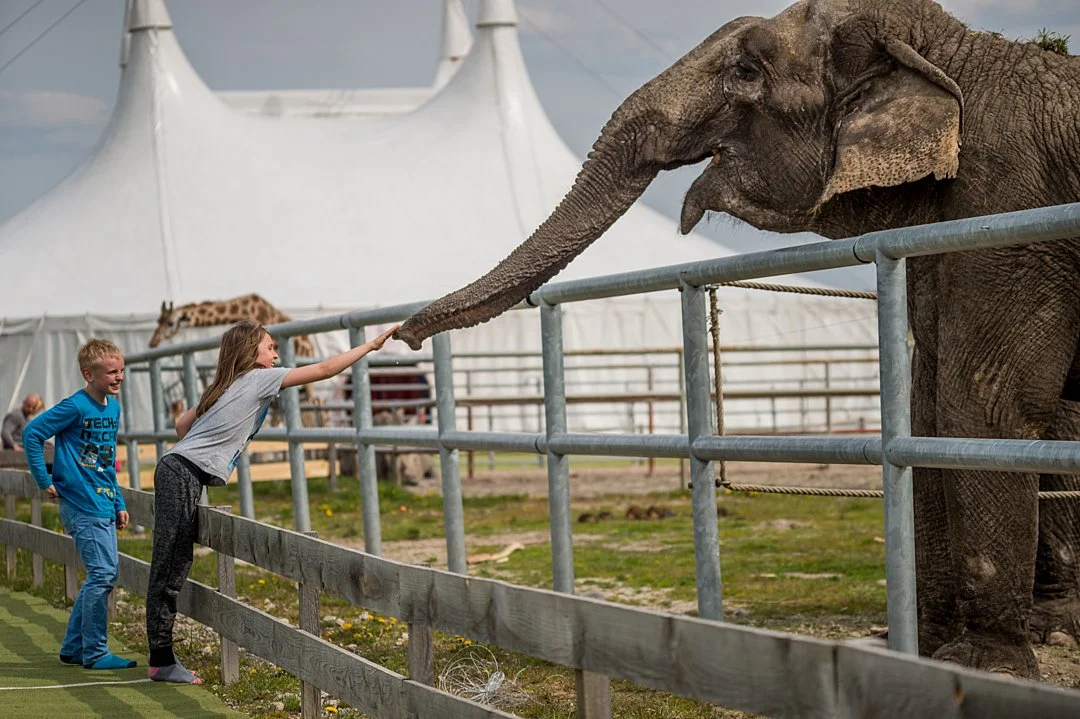
Visitors with an elephant at a circus and zoo in Germany. Germany, 2016. Jo-Anne McArthur / Born Free Foundation
That ideology emerges as children encounter the wider world; in which animals are regarded as useful objects and in which figures of authority, themselves unwilling to face the realities of animal exploitation, barely raise a murmur. Speciesism, the belief in the intrinsic superiority of human species over all others, takes over. Dogs become pets, pigs become food; cows become shoes, etc. Societal norms work hard to capture these beliefs - and the net is both wide and tight: “By the time we’ve reached adolescence, speciesism sets in to justify lifelong eating habits which are also tied up with cultural and gender identities, with family and seasonal traditions,” comments journalist Claire Hamlett for The Empathy Project. [6]
Academics Matthew Melsa and Kate Stewart map the cultural construction of human-animal relations in their book Our Children and Other Animals. They cite a visit to Hamley’s toy store, floor to rafters full of the representation of animals. “On the ground floor, stuffed toys predominate, with anthropomorphised animals posed so as to invite cuddles, often with human-like smiles and wide-eyed adoring expressions. These representations give way to more realistic hard plastic 'farmyard' animals higher up in the store. The transition models a shift from affection to objectification that is a hallmark of 'growing up', culminating in the objectification of real animals on the top floor. Here, sweets containing gelatine and other animal products are on sale, but there is nothing that might raise children's awareness that real animals are exploited and killed to produce them.” [7]
How animals help children learn, heal and connect
What a missed opportunity. Studies repeatedly show real benefits to children who share bonds with animals. Spending time with animals strengthens perspective-taking and kindness while reducing stress and anxiety. Successfully caring for an animal can make a child feel capable and valued. Kids who love animals are more socially competent and confident; showing a stronger affinity for nature [8], greater empathy towards their peers and, in another study, a greater willingness to enter pro-social and pro-environmental professions [9]. Then, of course, there’s the sheer joy that time with an animal can bring, where playfulness and energy levels are matched and love is unconditional. [10]
None of this comes as a surprise to Eve Moore, head of adoptions for animal welfare charity Underdog. In its UK therapy dog programme, trained dogs visit classrooms to support anxious kids. “Our work has shown that children who regularly engage with dogs develop stronger emotional intelligence,” says Moore.
In one partner school, students struggled with confidence and social skills. “After weeks of gentle interaction, a little girl who had previously been mute, found the confidence to read to her therapy dog,” says Moore. It was the first time she had spoken in school. Over the course of a term, their teachers reported not only improved literacy but also noticeable gains in patience and teamwork.
Dogs, inevitably, are absolute winners in classrooms. “They’re non-judgemental,” says Moore, affectionately. “They respond to kindness and care in a way that children can see and understand immediately. This makes them perfect partners for teaching respect, responsibility and compassion. One of the most positive aspects of the work is witnessing the transformation in how children perceive and treat animals once they understand they are sentient beings with feelings and needs.”
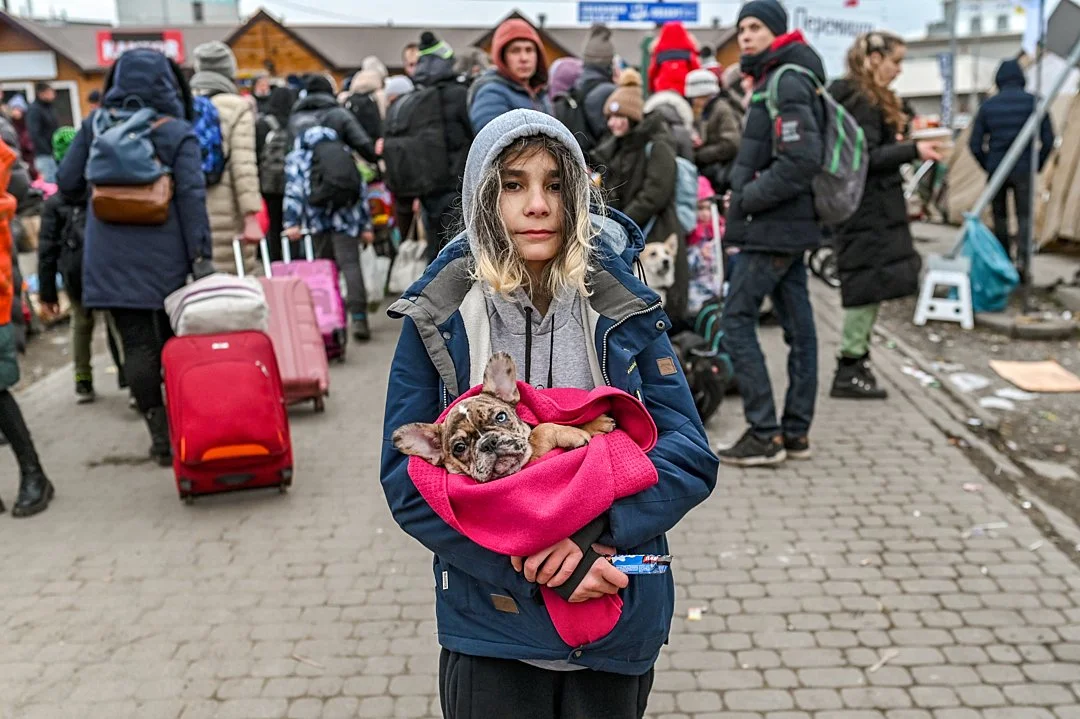
“While adults have yet to settle on a way of describing our relationship to animals, a 2021 study suggests, for children, at least it may be closer to kin.” A young Ukrainian refugee carries her beloved dog in her arms as she waits at the Ukrainian Polish border. Forced to flee her home with only what she could carry, she chose her dog. Poland, 2022. Milos Bicanski / We Animals
As the link between ecological collapse and humanity’s break from nature becomes clear, advocacy groups are working against time to embed empathy for other species amongst children. In the past five years, Animal Aid has reached over 60,000 students and teachers with school talks. Gen Earth’s collaboration with Born Free invites students to ask whether animals should have the same rights as humans. Roots & Shoots, by the late visionary Dr Jane Goodall, addresses environmental and humanitarian challenges. The programme is grounded in Goodall’s core belief: respect and kindness to all life. Ninety five percent of attendees at the RSPCA’s recent citizens assembly supported animal welfare modules in schools [11] (despite the charity’s adherence to factory farming through its gruesome Assured scheme). In 2022, Pakistan worked with activists to create a welfare curriculum in Islamabad schools. [12]
Learning alongside
In the States, humane education (HE), steered by the Institute of Humane Education, is on the rise; classroom resources offered by PETA and Humane World for Animals rely significantly on its philosophies. Rooted in deep enquiry and action on global issues, this nuanced approach to learning centres critical thinking and compassionate communication. [13] Students, known as ‘solutionaries’, talk to stakeholders; from those being harmed by the status quo to those benefiting from it and more. [14] Root causes of real world problems are considered before responses are developed that encompass human, animal and ecological wellbeing; omit one of those three and any settlement will be partial and inadequate. In 2024, the Institute partnered with the UN Global Schools program to integrate sustainable development into school curricula. [15]
Zoe Weil is the Institute’s co-founder and president. “Our current systems are oriented towards getting a job and being globally competitive but we live in a complex, interconnected world,” she says. “If you don’t cultivate a solutionary mindset, you’re not going to see the impact of your choices on people, animals and the environment. No matter what careers they go to, [solutionaries] know how to build a world in which all life can thrive.” [16]
Where empathetic education flourishes most, however, is alongside animals who are safe, in sanctuaries built for their needs. Here, students can meet, not the brutalised creatures in factory farms or the dead-eyed ghosts in zoos, but perceptive, strong-willed individuals with their own powerful stories. “Sanctuaries can help students connect with animals and learn about various institutionalised forms of animal cruelty,” offers Meena Alagappan, executive director of the Humane Education Advocates Reaching Teachers Network. “And that can inspire them to try to change the oppressive systems these animals are subjected to.” [17]
It also teaches them about the animals themselves. Visitors to the Ark 2000 Sanctuary, for example, may meet Nicholas, an Indian bull elephant born into a zoo. Taken from his mother at the age of two, when he still needed her, Nicholas was trained to ride tricycles and walk on balance beams. At five, deemed too unruly to perform, he was ‘retired’ to a dark barn before being brought to the Sanctuary, aged 13, in 2007.
From Nicholas, students learn about abusive US zoos but they also encounter a spirited but solitary bull elephant, weighing in at an enormous 1,221 stone, whose favourite treat is wheat bran, which he carefully gathers up in his trunk, while making contented rumbling sounds.
Weil is thrilled with this development for HE. “Sanctuaries can save only so many animals but they save vastly more by having robust humane education programmes where students can come and learn,” says Weil. “I can only imagine how much sooner I would have become vegan if I had visited any kind of farmed animal sanctuary as a child.”
What children learn from a world that hurts animals
Animals are not the only victims of the brutality they suffer. In 2019, Roshni Trehan Ladny and Laura Meyer published Traumatised Witnesses: A Review of Childhood Exposure to Animal Cruelty. “Witnessing violence predicts and increases a child’s engagement in maladaptive behaviours, including the perpetration of violence towards humans and animal,” they wrote. The implications for wider society are profound, with some children experiencing “de-sensitization, decreased empathy, learned maladaptive coping mechanisms and other learned behaviours, and unresolved feelings of anger, fear, and resentment” - before potentially going on to repeat what they’ve seen, continuing cycles of sadism. This is true, whether the children witnesses violence toward humans or animals. [18]
The links between animal abuse and other types of violence are complex, intimately linked to trauma and powerlessness; children who abuse animals were found to be two to three times more likely to be directly abused themselves. [19] There is the oft-cited link between early animal abuse and serial killing and the high rates of domestic violence and rape amongst slaughterhouse workers [20].
Set against data showing that 59 percent of those who commit crimes against wildlife are also associated with other violent crimes [21], the spate of children across the UK currently trapping, torturing and killing wild animals - and filming the killings for social media clicks - looks part of a generational continuum. [22] Growing evidence shows that in homes where animals abuse occurs, the abuse of children is 641 times more likely. [23] And if all these different types of abuse are somehow connected, what then are the implications for a culture in which the tropes of everyday life - from the sausage in our breakfasts to the leather in our shoes; from the mother’s milk in our tea to the gelatine in our toilet paper - are rooted in similar acts of cruelty? And not simply rooted but aggressively defended?
How does it happen? Former Joint Master of the South Shropshire Hunt Robert Churchward recalled his first hunt, at the age of six. “I saw a bedraggled vixen baring [her] teeth,” he wrote. ”The hounds fell upon her and everyone cheered, and I joined in, so that my father’s friends would think well of me. The next few moments were important in my life. The hounds snapped at the vixen’s body; the flesh was torn away, and instinctively I felt sick. It was then, as I now realise, that I needed guidance. A few words from an adult expressing compassion for the tortured animal would have turned me against hunting forever. Instead, my father’s groom rode over to me. “You’re a lucky young man,” he said. “First time out, and a kill!” [24] In his later years, Churchward became a passionate anti-hunt advocate.
In 2023, the United Nations’ Committee on the Rights of the Child formally recognized the damage that witnessing violence, including to animals, can cause to children. [25] It’s hard to understand why it took so long. Watching a child being separated from an animal they love is heart-break in real time. [26] In that moment, when arms are torn from furry necks, children learn this: that connection to nature is considered retrograde; that compassion will be rejected as weakness; that the most innocent, including themselves, are simply fodder for punishment; that they are fools for caring.
And yet, around the world, children witness brutality every day. Humane World reports seeing or learning of children exposed to cruelty to animals in dogfights and cockfights, in slaughterhouses or in the world’s Extreme Markets, where animals are beaten to death in front of consumers. [27]
Meanwhile, initiatives such as the US’s 4H programme encourage children to raise young animals before taking them to slaughter, in order to cement the killer/carer paradox that characterises farming animals. For want of a better phrase, it’s a mind fuck.
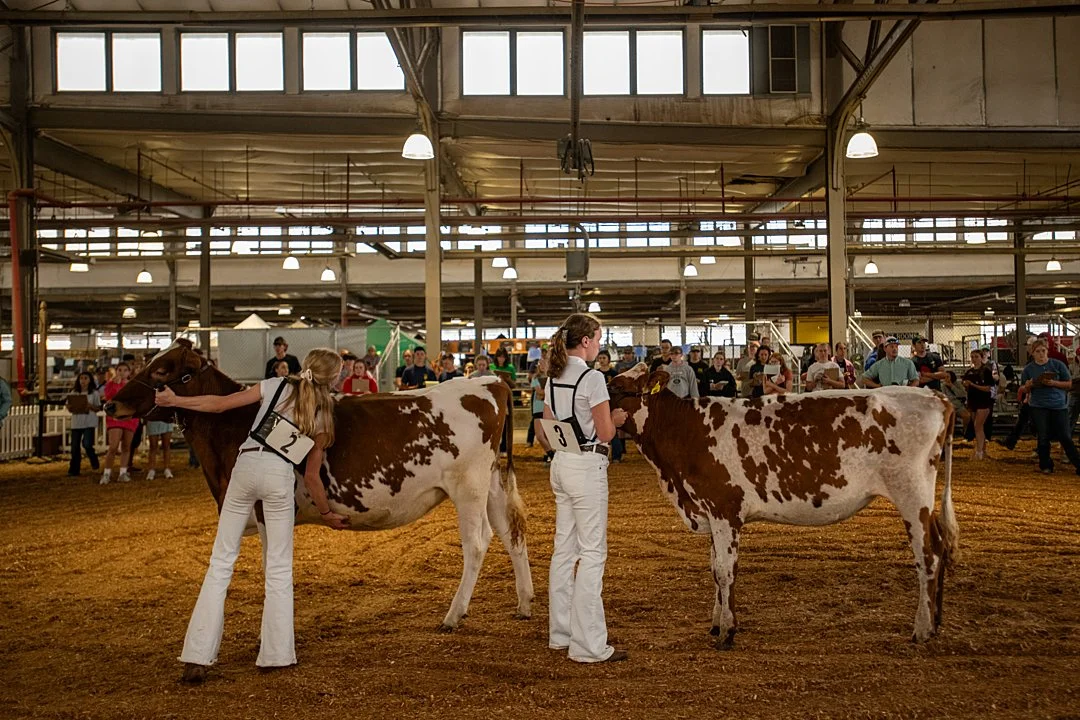
“Initiatives such as the US’s 4H programme encourage children to raise baby animals before taking them to slaughter.“ A pair of dairy cows are presented by youth at a large agricultural fair during a 4-H learning session. New York State Fair, Syracuse, New York, USA, 2024. Jo-Anne McArthur / Woodstock Farm Sanctuary /
Challenging human exceptionalism
Finally, there is all that is lost when we ignore loving connections with other animals - and not simply those pro-social behaviours. What about the heart rush when your dog erupts with excitement, simply because you have woken up in the morning; the beat when we meet the eyes of a fox on a winter’s evening; the feeling of watching a rescued animal sleep, just sleep, peacefully, maybe for the first time in their life? Caring deeply about animals is a rejoinder to contemporary values of exploitation and materiality; offering us the chance to live in alignment with professed values of compassion. It teaches us skills that are of value in broken systems, including the ability to be alongside another who is profoundly different, to accept that we may not always understand them but to try, nonetheless; to take joy in their very existence. Caring deeply about animals protects us all.
Webb remains determined: “Human exceptionalism is not a universal truth. It’s a worldview passed down by the dominant Western culture. Not something built into our biology, but something shaped by our experience. And if it can be learned, it can also be unlearned.”
Meanwhile, Chundrigar works to awaken the children to the treasures in their midst. The charity runs donkey camps, where donkeys - still a main means of transportation and haulage - and goats receive basic medical care. “When kids see an animal in distress, they think it’s funny. So we explain that goats feel like we do,” says Chundrigar. “We teach kids to be gentle with animals. And explain that they get scared just like we do.” [28] Watching a small boy, face serious with concentration (and a little wonder), tenderly wiping a goat’s eyes, suggests a kinder world is closer than we think. Whether we let it take hold for our children is another matter.
@acfanimalrescueofficial, ‘Transforming Lives…’ (Instagram Reel, 12 October 2025) <https://www.instagram.com/reel/DLFzJrvIwo-/ >
Miles Richardson and others, ‘A Measure of Nature Connectedness for Children and Adults: Validation, Performance, and Insights’ (2019) 11(12) Sustainability 3250 https://doi.org/10.3390/su11123250
M Wilks, L Caviola and P Bloom, ‘Children prioritize humans over animals less than adults do’ (2020) Psychological Science https://doi.org/10.1177/0956797620960398
L McGuire, SB Palmer and NS Faber, ‘The Development of Speciesism: Age‑related Differences in the Moral View of Animals’ (2022) Social Psychological and Personality Science https://doi.org/10.1177/19485506221086182
C Webb, ‘The Biggest Threat to Humanity’s Survival (According to “Not the End of the World”)’', (Next Big Idea Club) https://nextbigideaclub.com/magazine/biggest-threat-humanitys-survival-not-think-bookbite/56819/?srsltid=AfmBOoocX4skCJajKHaX3r2QyLCSohlS2dA676Izm7WHm-CGghQyOKPz
C Hamlett, ‘Re‑Becoming Vegan’ (2022) The Empathy Project https://www.theempathyproject.co.uk/magazine/re-becoming-vegan
Matthew Cole and Kate Stewart, ‘The distance between us’ (2020), The Psychologist (British Psychological Society) https://www.bps.org.uk/psychologist/distance-between-us
Alexia Barrable and Samantha Friedman, Developing a Connection to Nature: The Role of Pet Ownership in Childhood (2024) People and Animals: The International Journal of Research and Practice 12 https://docs.lib.purdue.edu/paij/vol7/iss1/12
W Zhang, E Goodale, J Chen, J, (2014). How contact with nature affects children’s biophilia, biophobia and conservation attitude in China. Science Direct https://www.sciencedirect.com/science/article/abs/pii/S0006320714002389?via%3Dihub
@monteirojuliana1218 (Instagram Reel, boy and goat play together, 20 November 2025) https://www.instagram.com/reel/DQ5CIbYEu2l/?igsh=MXNhZHZ6N29hN2g1cA==
RSPCA, ‘RSPCA Citizens’ Assembly’ https://16174e70-ac55-4a42-980e-86616824258c.usrfiles.com/ugd/16174e_996f3ad1e73e40f89e146c6c012775d0.pdf
Shahjahan Khurram, ‘In a first, Pakistan to introduce animal welfare course for Islamabad’s schools’ Arab News PK (18 September 2022) https://www.arabnews.pk/node/2164356/pakistan
Humane World, ‘Humane Education’ https://www.humaneworld.org/en/humane-education
The Solutionary Way with Zoe Weil (YouTube, 31 May 2022) https://youtu.be/Col-JYJmDHo
UN Sustainable Development Solutions Network (SDSN), ‘Global Schools’ 2024 Annual Report Showcases New Initiatives and Global Impact’ (18 August 2025) https://www.unsdsn.org/news/global-schools-2024-annual-report/
‘Zoe Weil Says Humane Education Can End Factory Farming, And She’s Got a Plan’ (YouTube, 022) https://youtu.be/OEMNHjaw9nc?si=HZjWmPP5Jzx9uPQA
Wild Animal Sanctuaries: The New Face of Humane Education (YouTube, Whale Sanctuary Project, 3 years ago) https://youtu.be/OVHTM5jo2Hg
Roshni Trehan Ladny, Laura Meyer, Traumatized Witnesses: Review of Childhood Exposure to Animal Cruelty (2014) PudMed Central https://pmc.ncbi.nlm.nih.gov/articles/PMC7683760/
Richard Lee-Kelland and Fiona Finlay, ‘Children Who Abuse Animals: When Should You Be Concerned About Child Abuse? A Review of the Literature’ (2018) 103 Archives of Disease in Childhood 801–805 https://pubmed.ncbi.nlm.nih.gov/30018068/
Jessica Slade and Emma Alleyne, ‘The Psychological Impact of Slaughterhouse Employment: A Systematic Literature Review’ (2023) 24 Trauma, Violence & Abuse 429–440 doi:10.1177/15248380211030243 https://pmc.ncbi.nlm.nih.gov/articles/PMC10009492/
Wildlife and Countryside Link, 2024 Wildlife Crime Report (NWCU analysis, 2025) https://www.wcl.org.uk/wildlife-crime-press-release-2025.asp
Wildlife and Countryside Link, ‘Lack of wildlife crime convictions opening the door to other serious crimes’ (10 November 2025) https://www.wcl.org.uk/wildlife-crime-press-release-2025.asp
Chelsea M Spencer, Noah D Renken, Mariah M Moore and Claire Coughlin, ‘An exploration of the relationship between cat, dog, and small pet abuse and child abuse’ (2025) Child Abuse & Neglect 169 107747 https://www.sciencedirect.com/science/article/pii/S0145213425005034?dgcid=coauthor
Bel Jacobs, ‘In defence of foxes’ (The Empathy Project, 22 September 2024) https://www.theempathyproject.co.uk/magazine/in-defence-of-foxes
Committee on the Rights of the Child, General comment No. 26 (2023) on children’s rights and the environment (including climate change) CRC/C/GC/26 https://docs.un.org/en/CRC/C/GC/26?utm_source=chatgpt.com
@vegangreenplanet, ‘Teaching compassion …’ (Instagram Reel, 18 October 2025) <https://www.instagram.com/reel/DP9UTZMkQkV/?igsh=OXZuZjZsMHZwZTg2
Kitty Block, ‘UN recognizes children’s right to be free from exposure to violence against animals’ (Humane World for Animals, blog post, date unknown) https://www.humaneworld.org/blog/un-recognizes-childrens-right-be-free-exposure-violence-against-animals
ACF teaches kids to be doctors: https://www.instagram.com/reel/DLHmnmeotUi/?utm_source=ig_web_copy_link&igsh=NTc4MTIwNjQ2YQ=