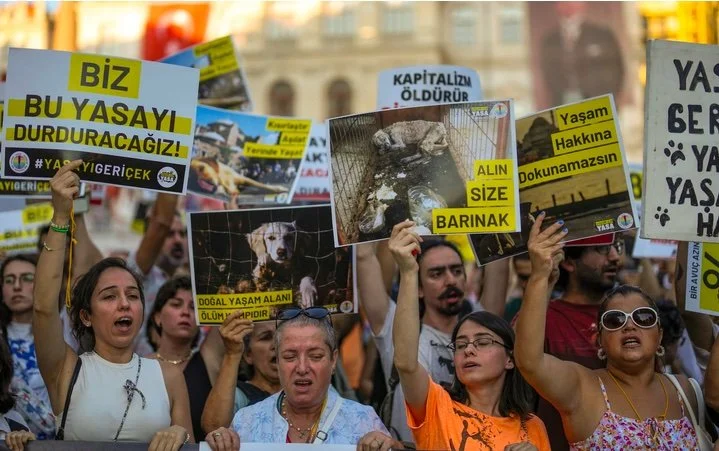
Pro-animal rights activists have taken to the streets of Istanbul, in 2024, protesting against the legislation. Credit: AP/KHALIL HAMRA
Global delegates are currently gathered for the UN Climate Change Conference (COP31) at the Antalya EXPO Centre to discuss the abysmal state of the climate. After a summer in which temperatures soared and wildfires raged, few conferences have felt so urgent; the world waits with bated breath.
But as representatives move from one zone to another, talking earnestly about climate justice and indigenous rights, those familiar with the resort city may notice a glaring absence. Antalya once teemed with friendly dogs: dogs sleeping in the shade, lounging outside cafes; dogs loved and cared for by local communities. No holiday Instagram post seemed complete without them. Today, Antalya’s streets and the streets of dozens of other cities around Türkiye are empty and the animals that once roamed them? Gone.
Concerned about attacks and the spread of disease - and with COP31 looming on its agenda - the Turkish Government roughly dispensed with its humane capture-neuter-vaccinate-return (CNVR) approach towards a new one. Introduced in July 2024, Law No. 7527, known by animal groups as ‘The Massacre Law’, mandated municipalities to collect and confine its four million stray dogs. Due to the required scale and speed of execution, what has ensued is, without overstatement, a bloodbath.
Reports describe dogs killed in horrific circumstances, appalling shelter conditions, mass graves and alleged cases of animals buried alive. Municipal teams reportedly use steel tongs, wire snares and tranquiliser darts to drag dogs from the communities where they were born and cared for. Puppies, elderly dogs and healthy animals have reportedly been thrown into crowded vehicles, raising concerns about injuries and inhumane handling. The ‘shelters’? Before the cull, capacity stood at 105,000. No municipality was ready. Concrete pens are overcrowded and exposed to extreme weather while the dogs lack bedding and access to food and clean water. The shelters are effectively death camps.
Warning: graphic content.
Filmed evidence claws at the heart. In one incident, footage showed collectors in Konya dragging an elderly dog with a catch pole while people try to prevent him from being taken. He had lived in these streets for 9 years; loved and cared for by the community. He died on the way to the van and a man trying to protect him has been arrested, charged and detained. In another, a beautiful white retriever, who has just given birth, is taken - along with her 10 puppies - to another shelter, to make her way and to protect her newly born without food, water or care. Her terrified eyes, the constant dip of her head towards her pups, show a visceral understanding: none will survive here.
“In Osmangazi, dog catchers keep pregnant dogs alive in separate cages until they give birth; only then do they kill them and are paid 10 Turkish lira [about 15p] per dog.” writes animal welfare campaigner Lisa Ozmelek in a LinkedIn post. “To make more money, they literally count unborn puppies inside pregnant mothers.” A text message between municipal animal shelters, leaked to Turkish television news channel Sözcü TV, read: “Write down the unborn puppies. We'll divide them between us."
There are reports of mass graves alongside two of the shelters. Images from Erzurum Municipal Shelter in February 2025 showed a landfill site filled with dog carcasses, puppies and kittens among them; little bodies, limp and still furry. “Additional evidence shows dogs who appear to have been buried alive, live dogs scrambling out of the pit and newborn puppies and pregnant dogs in mass burials at this same site,” writes Ozmelek. “In Konya, vehicle tracks lead down to a deposition site of street dogs killed by the municipality. They have also been routinely dumped in mass graves, landfill sites and in bins. Sometimes they are just left in the open air, even on the streets where they collapse, with the tranquiliser darts still attached to their bodies.”
Adaptation goals and environmental standards violated
Behind Türkiye’s apparently affectionate street animal culture, it now appears something different was brewing: a hatred so visceral that its unleashing has been explosive. The feeding of street animals, once part of life, has now been banned; feeding stations have been smashed up. Dogs have been grabbed from gardens and private shelters (350 from one rescue, while its owner was on a protest). Those who care about dogs have been openly mocked; online hate groups and associated right-wing social media accounts work hard peddling myths that street and companion animals are an existential public security threat and a source of terror.
Worrying about dogs, street or otherwise, while the world faces environmental collapse may feel marginal. That is certainly what Türkiye hopes COP31 delegates will think. Now, a loose coalition of domestic and global advocates are arguing that the ‘Massacre Law’ actively undermines the global climate-health adaptation agreements being negotiated inside the summit. While the dogs themselves may not matter to the authorities, they say, their treatment does. Unleashing brutality against street animals works in direct and violent counterpoint to aspirations to tackle the spread of zoonotic disease, health adaptation and civil society: all concepts supposedly central to the ethos of COP.
It was the World Organisation for Animal Health and World Animal Protection that pinpointed mass culling as an ineffective way to manage disease. Mass culling breaks herd immunity, leaving urban centres vulnerable to climate-driven zoonotic surges, including rabies. Ecosystems already altered by climate change exacerbate conditions. Forcing millions of community animals, already sick and injured, into crowded, disease-ridden shelters shatters local biological barriers; unmanaged mass animal waste, decomposing remains, and inadequate sanitation pollutes groundwater. It’s a smorgasbord of environmental degradation.
At the same time, international climate policies such as The Paris Agreement and UNESCO Declaration of Ethical Principles in Relation to Climate Change (2017) explicitly incorporate ethical governance, human rights and the protection of vulnerable groups into their frameworks. While COP31 President Murat Kurum touts Türkiye's presidency as built on "dialogue, consensus, and action", his government is disregarding widespread domestic protests and international outcries over the treatment of its animals. “The hypocrisy is sickening,” writes Ozmelek. “How can they talk of sustainability and One Health while they turn their backs on ETS No. 125 [European Convention for the Protection of Pet Animals] and reject CNVR in favour of what has become the largest slaughter of dogs in modern history?”
Finally, there are the children. In 2024 (ironically the same year as the Massacre Law was introduced), the UN Committee on the Rights of the Child published General Comment No. 26 (2023) on Children’s Rights and the Environment, with a Special Focus on Climate Change. GC26, as it is known, states that “children must be protected from all forms of physical and psychological violence and from exposure to violence, such as domestic violence or violence inflicted on animals.” Türkiye is a state party to the Convention but in its mass culling of dogs, ignores its commitment to its young people.
Nowhere was this more evident than on Friday October 16th, when up to 200 dogs were seized from Ege University by Bornova Izmir municipality. These were community animals being cared for by the students of the University in a dedicated area. Many were elderly or disabled; frightened but still docile, they stumbled heavily from their enclosures. When students and teachers tried to protect the dogs and stop the vans from leaving, they were set upon by riot police with teargas. And the dogs? Most likely dead or dying. The grief amongst Türkiye’s young people are immeasurable.
A global wave of hatred
In October, the Turkish government announced that 100% of stray dogs had been removed. “The truth is, that they have been incarcerated in inhumane and appalling conditions and annihilated,” writes Ozmelek.
The ‘Massacre Law’ is only one manifestation of a global wave of hatred against street animals. In the run-up to FIFA World Cup 2030, Morocco is enacting similar killings. Violence against dogs in India, Pakistan and countries in Eastern Europe is rising. And where there is the public killing of animals, there is an uptick in other kinds of violence. In Turkey, the ‘Massacre Law’ has seen a spike in online cat torture. Landmark research has made clear the links between violence towards animals and violence towards humans. Individuals who abuse animals are five times more likely to commit violent crimes against humans; in households where animal abuse takes place, child abuse is 580 times more likely to occur. What is happening in Türkiye has implications for all our futures.
There are humane options. The cities of Lucknow, Vadodara and Rudrapur in India, for example, worked with both local residents and government to put in place widespread sterilisation and vaccination plans. Costa Rica has appointed a National Animal Welfare Coordinator and funded a national pilot project to provide training to municipalities in dog population management (DPM)-related skills. From local data, stakeholders in Kljuc, Bosnia, crafted a realistic plan they could resource locally and continue to develop with improved communication and leadership of DPM. Robust public health strategies that include humane animal management are fundamental to a nation's adaptation, to its climate resilience and to disaster response plans; Türkiye could have picked any one.
The country recently announced its intention to host the 2036 Summer Olympic and Paralympic Games in Istanbul and is currently assembling a formal bid. Time and again, major international events like COP31, like FIFA, place host cities’ free-roaming dogs and cats at terrible risk as public spaces are prepared for global audiences. In response, International Companion Animal Management Coalition (ICAM) has published a policymakers' briefing: 'Hosting Without Harm: Major Events and Free Roaming Dogs and Cats’. The hope is that the briefing can be used “as leverage with the government and the International Olympic Committee to make humane dog and cat population control a requirement for any winning bid,” writes ICAM’s Patrick Gerard.
BarınakTakip is an independent civic monitoring platform creating a shelter investigation network through volunteer-submitted visit reports and shared data. Ozmelek herself has meticulously gathered a dossier of over 130 pieces of evidence, including testimony from journalists, people who’ve had their land seized, young pepper-sprayed students, rescues that were raided. From this, she has built a campaign, Where Are the Dogs. It has clear asks of COP31 delegates: share the work on social media to keep the dogs (those missing, those dying and those dead) front and centre; visit municipal shelters in Antalya; adopt, adopt, adopt - and support grassroots organisations working under extreme duress.
“There are activists on the ground going into places most of us would never have the balls to go. They are risking everything to expose what the world refuses to see,” writes Ozmelek. “Filming, documenting, collecting testimony and preserving evidence of what is being done to dogs and, increasingly now, to cats. They’re doing it because they know that without the evidence, the truth will just be labelled fake news, denied or ignored. They’ve been intimidated, labelled troublemakers and even terrorists for speaking out and exposing what they see. I know of private shelters that have faced arson attacks and individuals who have faced violence and personal threats. Despite this, they keep going back and collecting the evidence.”
The emotional turmoil, the concern for the dogs, the outrage at innocent lives so brutally taken continues to drive campaigners. “The dogs’ bodies are buried in hastily dug pits, sometimes while the dogs are still alive,” writes Ozmelek. “They have been discovered dumped on waste land, beside rivers and in bins. Darted with tranquilisers, their bodies are left in the street with the needles still attached to them. They have been dragged mercilessly away from the communities which fed and loved them despite the protests of the citizens who try to protect them. They have been stolen from private land and shelters, and been seized from university campuses where students have devoted years to building infrastructure to house them and keep them safe. They have been condemned to die in these municipal camps where they are abandoned without food, water or medical attention.”
“I implore all attendees at COP31,” she continues. “Please open your eyes. Please see the truth. Please speak to the citizens and activists. Please ask - where are the dogs?”