Comment: The Slaughterhouse and the State
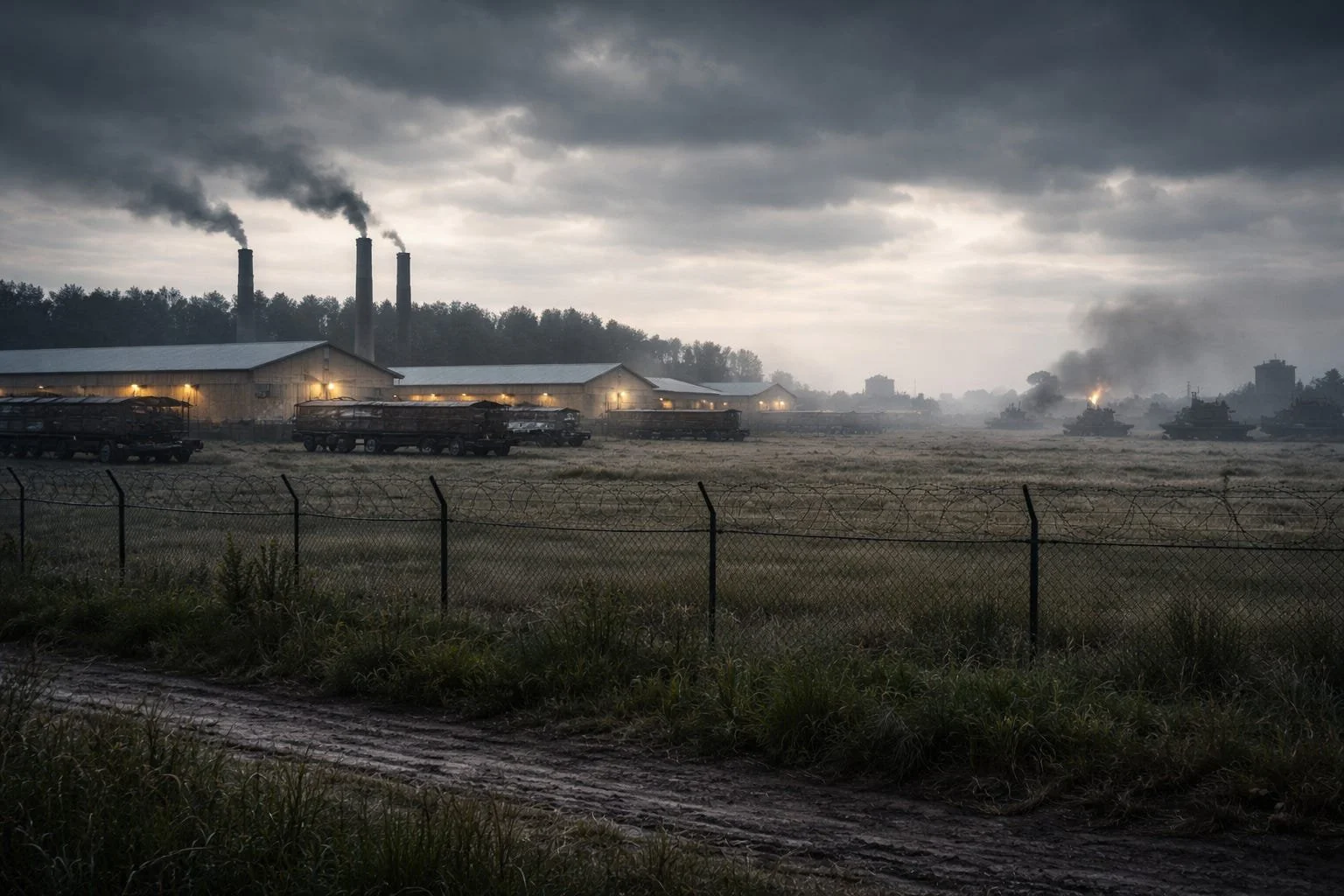
Leo Tolstoy wrote, “As long as there are slaughterhouses there will always be battlefields.”
It is one of those lines people either dismiss as exaggerated or recognize as terrifyingly exact. Most people do not want to linger with it. It presses too hard on the conscience. It suggests that violence is not merely an event, a policy, or a crisis that erupts now and then in some distant place. It suggests that violence is a culture. A habit of mind. A way of organizing perception itself.
That is why his statement still matters.
Tolstoy was not making a crude argument that every person who eats animals becomes a soldier, or that factory farming directly causes war through some simple chain of effects. His insight was deeper. He was pointing to a continuity of consciousness. When a society builds ordinary life on the organized domination and killing of the vulnerable, it does not confine that moral injury to one corner of existence. The wound spreads. The habits spread. The logic spreads.
A civilization that becomes comfortable with slaughter does not merely tolerate one form of killing. It learns how to normalize violence, disguise it, bureaucratize it, and place it beyond ordinary moral scrutiny.
That is where the slaughterhouse meets the state.
The school of desensitization
The modern slaughterhouse is not only a site of killing. It is a school of desensitization. It is a place where living beings become units, bodies become inventory, suffering becomes cost calculation, and death becomes throughput.
Its language is sanitized because the truth is unbearable. We speak of production, processing, efficiency, and output. We call flesh “product.” We call confinement “housing.” We call mutilation “standard practice.” We call mothers “breeders.” Every euphemism performs the same function. It places distance between act and conscience.
That distance matters.
Violence rarely survives by asking to be seen clearly. It survives by becoming ordinary. It survives by breaking moral attention into pieces small enough to bear. It survives by teaching people not to look too closely, not to ask too many questions, not to connect one form of suffering to another.
The slaughterhouse is a perfected institution of this fragmentation. It requires emotional partitioning on a vast scale. Workers must suppress empathy in order to function. Consumers must suppress knowledge in order to continue. Entire industries must suppress truth in order to preserve legitimacy.
The result is not only the death of animals, horrifying as that is. The result is a public schooled in moral compartmentalization.
And that schooling does not remain in agriculture.
The logic of domination
Once a culture accepts the principle that sentient life may be subordinated to profit, habit, convenience, and power, it has accepted more than a menu. It has accepted a structure of thought. It has accepted that the strong may define the value of the weak. It has accepted that suffering may be rendered invisible when visibility becomes inconvenient. It has accepted that efficiency can outrank compassion.
This is not only how animals are treated. It is how empires think. It is how oligarchies think. It is how colonial systems think. It is how authoritarian states think.
Domination is never satisfied with a single object. It is a pattern, and patterns repeat.
Whenever a society trains itself to look at a living being and first ask, “What can be extracted?” rather than “What is owed?” it has already entered the grammar of domination. That grammar can attach itself to animals, workers, prisoners, migrants, the poor, and political enemies. Different categories, same syntax. Some lives are treated as fully real. Others are treated as instrumental. Some are grievable. Others are consumable.
The state, at its worst, formalizes this logic.
We are often taught to think of public violence as exceptional. War is described as tragic but necessary. Police brutality as an unfortunate excess. Environmental destruction as the cost of growth. Labour exploitation as economic reality. In each case, what is really being defended is not necessity but habituation. People have learned to live inside structures that injure others, and to call that arrangement normal.
This is why factory farming matters politically, not just ethically. It reveals the mechanics by which violence becomes respectable.
First, the victims are hidden.
Then the language is cleansed.
Then the suffering is justified as necessary.
Then the profits are protected.
Then anyone who objects is dismissed as emotional, unrealistic, radical, or naive.
That sequence should sound familiar because it appears everywhere domination seeks legitimacy.
A public trained not to see
The state does not need every citizen to become cruel. It only needs enough citizens to become detached. It needs people to believe that suffering, while regrettable, is simply part of how the world works. It needs them to see the machinery but not question the design. It needs them to absorb the feeling that resistance is futile because power is permanent and violence is inevitable.
Factory farming teaches exactly this lesson.
It teaches that massive suffering can be folded into ordinary life without disrupting social order. It teaches that beings can scream beneath the surface of a system while the culture above them keeps shopping, scrolling, congratulating itself, and discussing civility. It teaches that atrocity can be routinized. That moral shock fades. That profit can launder brutality into banality.
Once people have learned this lesson with animals, the broader consequences are immense.
A public trained to ignore cages will not easily recognize other cages.
A public trained to accept mechanized suffering for pleasure and convenience will struggle to resist mechanized suffering for security, nationalism, or economic gain.
A public trained to speak in euphemisms about slaughter will be vulnerable to euphemisms everywhere else: collateral damage, enhanced interrogation, urban clearance, labour flexibility, border security, strategic necessity.
Language becomes anesthesia. And anesthesia is one of domination’s most effective tools.
Not equivalence, but continuity
This is not an argument for false equivalence. War and animal agriculture are not the same institution. Human histories of empire, racism, nationalism, and class rule have their own causes and trajectories. The point is not to flatten every form of violence into one indistinct mass.
The point is to identify a moral continuum.
Cruelty does not need to be identical in every setting to be spiritually related. The deeper connection lies in what systems of domination require from us: numbed perception, split conscience, managed empathy, obedience to normalized harm.
That is why veganism is larger than diet. Larger than personal purity. Larger than lifestyle branding and consumer identity.
At its deepest level, veganism is a refusal of trained indifference.
It rejects the lie that violence becomes innocent when it becomes customary. It refuses participation in a structure that depends on distance between appetite and consequence. It seeks to restore moral coherence where culture has trained fragmentation.
It says that compassion cannot remain selective without becoming unstable.
What kind of consciousness are we practicing?
This is also why veganism unsettles people beyond the plate. It does not merely ask what we eat. It asks what kind of consciousness we are practicing.
Are we cultivating reverence, or domination?
Are we disciplining appetite, or rationalizing it?
Are we widening moral attention, or shrinking it to fit habit and convenience?
These are political questions because consciousness always becomes structure sooner or later.
A society is built not only by laws and institutions, but by what people are taught to notice, what they are trained to ignore, and whose suffering they have learned to dismiss. Public life rests on moral perception. If that perception is corrupted in everyday life, no constitutional language can fully save us.
People habituated to domination in one realm will not reliably resist it in another. They may object when the victims look like them, speak like them, or vote like them. But the deeper principle of non-domination will remain weak because they have never fully embraced it.
That is one of the central failures of modern liberal society. It speaks eloquently of rights while resting comfortably atop immense systems of sanctioned violence. It condemns tyranny in speeches while normalizing the total control of billions of sentient beings in practice. It wants the language of compassion without the cost of transformation.
But peace cannot be built on a foundation of ritualized brutality.
We cannot train ourselves in domination and expect to harvest justice.
We cannot turn living beings into machinery and expect not to become more mechanical ourselves.
The inward damage
The damage is not only external. It is inward. Every system of normalized violence diminishes the moral imagination of the people who live within it. It teaches us to become smaller than we are, less responsive, less honest, less able to feel the full significance of another being’s existence.
It encourages a civilization of managed empathy, empathy deployed selectively when it is socially rewarded, withheld when it is economically inconvenient.
That kind of civilization is always in danger.
Not only because it harms its victims, though it does. Not only because it devastates the earth, though it does. But because it erodes the interior capacities upon which any humane society depends. Compassion, moral clarity, disciplined perception, reverence for life, these are not decorative values. They are civilizational infrastructure. Once they weaken, domination finds easy ground.
Tolstoy saw this with unusual clarity. The battlefield does not begin when troops gather. It begins when conscience has already accepted that power grants permission. It begins when the strong have learned to narrate the suffering of the weak as necessity. It begins when killing has become administratively ordinary. It begins when society has practiced not seeing.
The slaughterhouse is one of the places where that practice is perfected.
Before the battlefield appears
To reject it, then, is not to retreat from politics into private virtue. It is to confront one of the most basic moral trainings of the modern world. It is to say that peace begins in perception. It is to say that justice is indivisible. It is to say that domination anywhere is not irrelevant to domination elsewhere.
The task before us is not merely dietary. It is ethical, spiritual, and political. We must recover the capacity to see clearly what violence does to both the violated and the violator, to both the victim and the culture that authorizes the wound. We must stop treating compassion as sentiment and begin recognizing it as social intelligence.
The slaughterhouse and the state are joined wherever life is downgraded into utility.
If we want a more peaceful world, we will need more than anti-war slogans and better leaders. We will need to challenge the deeper habits that make organized violence seem normal in the first place. We will need to unlearn the logic that some lives may be consumed for the comfort, appetite, or ambition of others. We will need to build a culture in which empathy is not the exception but the starting point.
Only then do we begin to step away from the battlefield, before it appears.
Further Reading: Animal Oppression and Human Violence by David Nibert