Tell it like it is: the case for honest labelling
Could the number be up for misleading labels on animal product packaging?
It’s all about labels. Earlier this month, the EU banned the use of 31 traditional meat terms such as bacon, beef, steak and chicken on plant-based products. part of stated efforts to support animal farmers and reduce consumer confusion.
Climate and animal rights groups are furious, claiming that the decision will create more confusion, not less, just as people are trying to eat less meat. “Consumers know what vegan steak means,” stated Pascal Bieri, founder of food tech innovators Planted. [1] “These words tell you how something cooks, how it tastes, where it fits on a plate. They're useful. Stripping them away doesn't create clarity, it creates friction.”
“For someone beginning to incorporate more plant-based meals into their diet, familiarity matters,” agreed The Vegetarian Society’s Deirdra Barr, in the Guardian. “Language helps people navigate change, and banning familiar words only makes that transition harder.” [2]
But a parallel movement around labelling may be gaining traction - and this time, it’s targeting animal products themselves. Advocacy groups Compassion in World Farming, Animal Law Foundation and Humane World for Animals have teamed up to draw focus to the ways in which animal products are offered to consumers: ways that hide, very deliberately, the reality of how most animals are kept and killed. They are not without support: the launch, Animals Farmed, at the Houses of Parliament, attracted 60 MPs from across parties.
Make your way along most meat and dairy aisles and you’ll see images of animals looking healthy and happy, running about outdoors, watched over by kindly farmers. If only. “Our polling reveals a disturbing gap between what people THINK has (or hasn’t) happened to animals on farms and in abbatoirs, and the grim reality,” posted Claire Bass from Humane World.
“The liberal use of phrases like ‘welfare assured’ by big names like Tesco on products from animals who have been gassed, caged and mutilated is clearly misleading consumers. The meat industry’s propaganda has created an Orwellian dystopia, where animals suffer under a veil of marketing doublespeak that comforts shoppers that all is well down that the farm. It is not, and we need Governments to force the meat industry to put truth on the label, just as they did the tobacco industry.” [3]
Images of animals joyfully inviting their own consumption are so incongruous that academics Matthew Melsa and Kate Stewart coined a term for it: “‘suicide food.” Its ubiquity, they say, “highlights the extent of cultural estrangement from real exploited animals, who are anything but suicidal.” [4]
Animals Farmed are calling for the introduction of mandatory ‘honest’ labelling. “Consumers deserve to know the truth,” actress and comedian Diane Morgan said, at the launch. “People care. They just don’t stand a chance when every message they get, every label, advert, website is designed to make them feel fine about something that they might actually not be fine with at all.”
Campaigners have tried to alert the public to intensive animal agriculture for decades. New generations actively seek to challenge cognitive dissonance. In 2023, Animal Aid and British vegan food company VFC’s billboard campaign “A Good Life?” set idyllic British countryside scenes against farming realities. Animal Justice Project’s recent campaign across the London Underground shows a mother pig in a farrowing crate. The caption: “if she were a dog, we’d call it abuse.” The pig industry is said to be “frustrated” by the images.
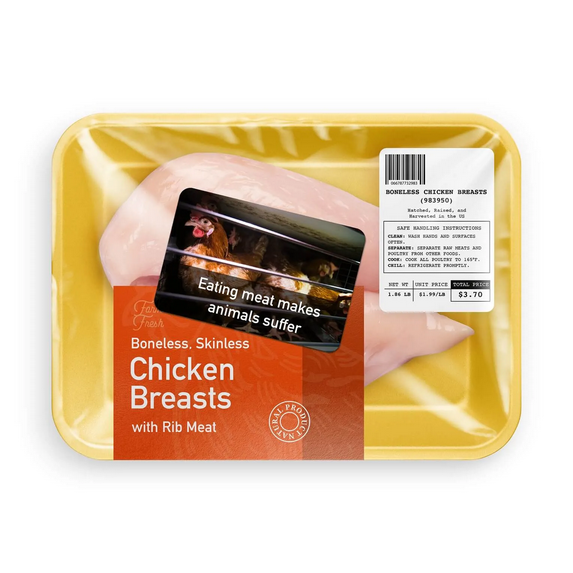
Researchers from TU Delft's Faculty of Industrial Design Engineering placed a photo of caged battery chickens on a pack of chicken breasts.
Currently, Project Slingshot’s masterful push “Don’t Buy It” exposes industry obfuscation of endemic violence: in this case, the pigs killed in the UK by CO2 gas. The campaign’s billboards are live in over 2,200 tube carriages; 11,000 people have signed the petition to ban gas chambers, and 4,500 of them have emailed MPs, Tesco and McDonald's asking why pigs are being killed in such an inhumane way. The launch video has been viewed 1.7 million times on Instagram; the soon-to-be released film, Gaslit, with key speakers from across animal and climate justice, deserves to be viewed by even more.
Nonetheless, the landscape for advocacy is challenging. Alongside fossil fuels, plastics and pharmaceuticals, animal agriculture is one of the most ecologically damaging industries on the planet. Led by monstrous conglomerates, slavishly coddled by governments, it is also one of the richest, making it keen to maintain business-as-usual-but-bigger-cheers. In 2020, in the EU, beef, dairy, pork and chicken lamb were subsidised up to 580 times more than legumes; all via the Common Agricultural Policy, which absorbs around a third of the EU’s budget. [5] A fair chunk of that appears to be going into wars around narrative rather than welfare.
In its new report Dangerous Distractions: How agribusiness narratives continue to undermine climate action, Changing Markets Foundation revealed co-ordinated efforts between major livestock groups to downplay emissions from the industry, attack independent science and frame rising meat production as compatible with climate goals. Most damning is the report’s analysis of conversations from the World Meat Congress and COP30. “The Food and Agriculture Organisation is your friend”, Thanawat Tiensin, FAO Assistant Director-General and Director of the Animal Production and Health Division and Chief Veterinarian confidently told meat producers. “The world needs more animal protein.”
At least seven of the nine nutrition experts who wrote the scientific foundation reviews for the US’s recently released Dietary Guidelines for Americans have ties to the meat and dairy, including National Cattlemen’s Beef Association and the National Pork Board. No surprise that the new guidelines nearly double the protein target currently eaten by Americans, already one of the world’s highest meat-consuming countries. [6] As if to prepare for this uptick in consumption, the U.S. House Committee on Agriculture is putting forward a Farm Bill that will remove from animals the bare minimum that makes hellish lives just a little more bearable. [7]
Meanwhile, the industry works tirelessly to make sure that what happens in factory farms stays in factory farms. In Australia, the copyright of undercover footage of bad practice, collected by Farm Transparency Project, was handed to the very slaughterhouse it had exposed. Now that’s power. [8]
Not hedgerows and happy cows
But, hard as the industry tries to steer conversations, the links between animal agriculture and some of the world’s most pressing global concerns are becoming too apparent to ignore. Animal agriculture is now clearly identified as the single largest driver of environmental breakdown, public health crises, global inequity and grinding animal cruelty. It contributes at least 30% of global direct GHG emissions to the climate emergency.
This month, the European Scientific Advisory Board on Climate Change called for more stringent measures to strengthen climate adaptation and reduce greenhouse gas emissions - by slashing food waste, cutting meat-eating, scrapping subsidies for climate-damaging practices, and taxing farmers for planet-warming pollution. At last November’s Climate Emergency Briefing, Professor Paul Behrens framed plantbased food systems as safeguarding food security and protecting farmers’ livelihoods, the dawn of a rural renaissance.
Meanwhile, people are starting to understand that animal farming is not the hedgerows and happy cows. This is significant. Till now, most shoppers have possessed only a baseline understanding of the brutalities meted out to farm animals on a daily basis: the caging of mothers, the culling of male calves, the chucking of male chicks into macerators, the castration of piglets without anaesthetic, the repeated impregnation of young females to build stock sizes. When AJP surveyed consumers about the production of milk earlier this year, 83% were surprised to hear that a cow and her calf had to be separated within the first 24 hours for humans to take her milk. This is a practice that has gone on for hundreds of years. Have we been sleeping? [9]
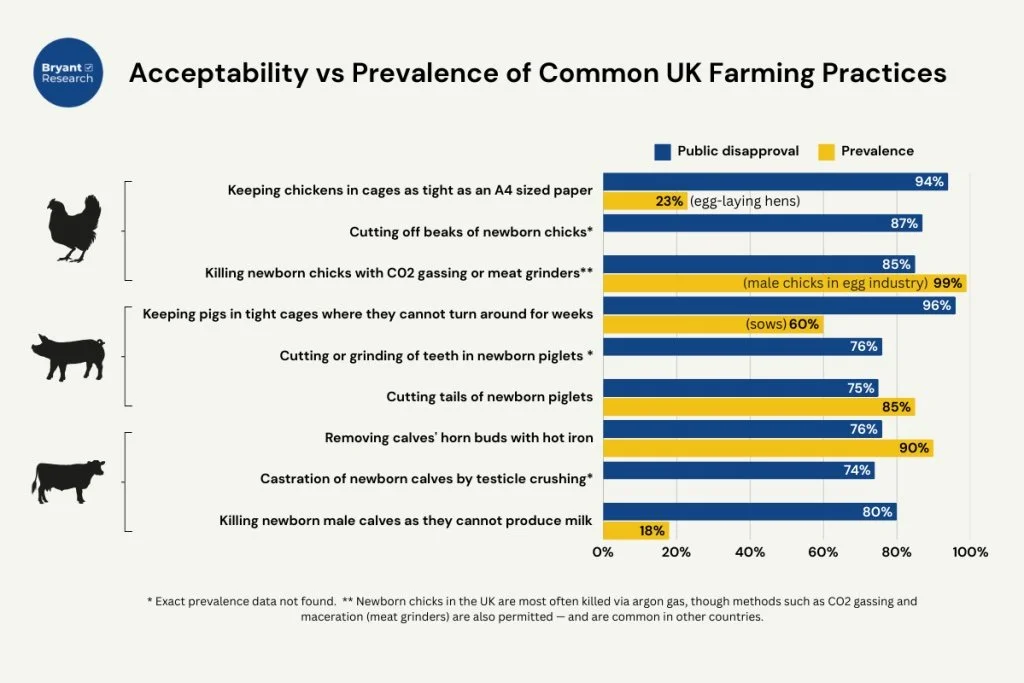
“Without exception, the gap between the two was yawning.” Image: Bryant Research
Last February, Bryant Research set the acceptability of common UK farming practices against just how often they took place. The gap between the two was yawning. Over three quarters disapproved of removing calves’ horn buds with hot irons; 90% of UK herds in the beef industry are disbudded that way, Almost 85% disapproved of killing newborn chicks with CO2 gassing or meat-grinders; all newborn male chicks in the UK are slaughtered in one of those ways. Over 96% disapproved of keeping mother pigs in farrowing crates; that’s where 60% of all mother pigs give birth every year. [10] When asked what percentage of animals raised for food lived in factory farms, survey respondents guessed 53%; the figure is, in fact, 83%. [11]
When shoppers find out the truth, they are horrified. Project Slingshot showed their gas chamber film to 18 meat-eating Brits; the response was unanimous. All of them were unaware that pigs and chickens are gassed to death in gas chambers. All of them were horrified and upset when they saw the footage. All of them agreed it was cruel and inhumane. All of them questioned whether killing animals can ever be humane. All of them were angry that this had been hidden from them.
Follow the Swiss
The UK coalition will be looking to Switzerland for inspiration. With a two year roll in from last July, a new law requires companies selling animal products to disclose whether they have come from animals who were mutilated without anesthetic. By the standards we see today, this is a bold move with a hidden agenda: the law is designed to support Swiss farmers who always use painkillers - but it still lifts the curtain on terrible things. Who ever advocated for the severing of legs from frogs without pain relief? Meanwhile, advocates are waiting to see what the labelling looks like in practice.
Given the urgency, what should we show on animal products? Campaigners have ideas. “Maybe we should have photographs of the conditions that the animals are kept in on the food when you’re buying it,” snapped conservationist Chris Packham. “That would change people’s shopping practices instantaneously.” Soil Association’s head of food policy Rob Percival added: “I’d like to see mandatory CCTV in industrial pig units … and a QR on products allowing a consumer to tune in and watch the shed and the processing plant in real time.” [12]
When the cafe at the University of East Anglia placed images of living animals alongside corresponding meat-based dishes (e.g., a cow next to beef bolognese), sales of vegetarian meals increased by 22%. [13] Researchers Anne-Madeleine Kranzbühler and Rick Schifferstein from TU Delft's Faculty of Industrial Design Engineering found the same response when they stuck a photo of caged battery chickens - and the message 'eating meat makes animals suffer' - on a pack of chicken breasts. [14]
Drawing the line
When the Government explored food labelling in 2024, they proposed a system of five tiers, with tier 1, the highest and Tier 5 allocated to products that didn’t even meet baseline welfare regulations.[15] Government discussion has all but stalled; CIWF et al want to kickstart it again.
Will labelling work? Depends. Humans have an uncanny ability to block out difficult information. The effectiveness of graphic health warnings on cigarette packs pale over time. But another case offers hope: in 2004, mandatory labelling for all eggs was introduced across Europe. Once 'eggs from caged hens' were labelled, cage-free egg production nearly tripled, now making up around 82% today.
Philip Lymbery, CIWF’s chief executive, sees similar on animal products: “Mandatory method-of-production labelling would allow shoppers to see instantly whether their meat and dairy came from intensive indoor systems, higher-welfare indoor set-ups or farms providing outdoor access.” [16]
Advocates for animals, for nature, for food resilience and for climate adaptation hope for three results from honest labelling. Firstly, that the public will be informed enough to choose better welfare animal products. Secondly, that producers still invested in archaic practices may be encouraged to shift up a gear.
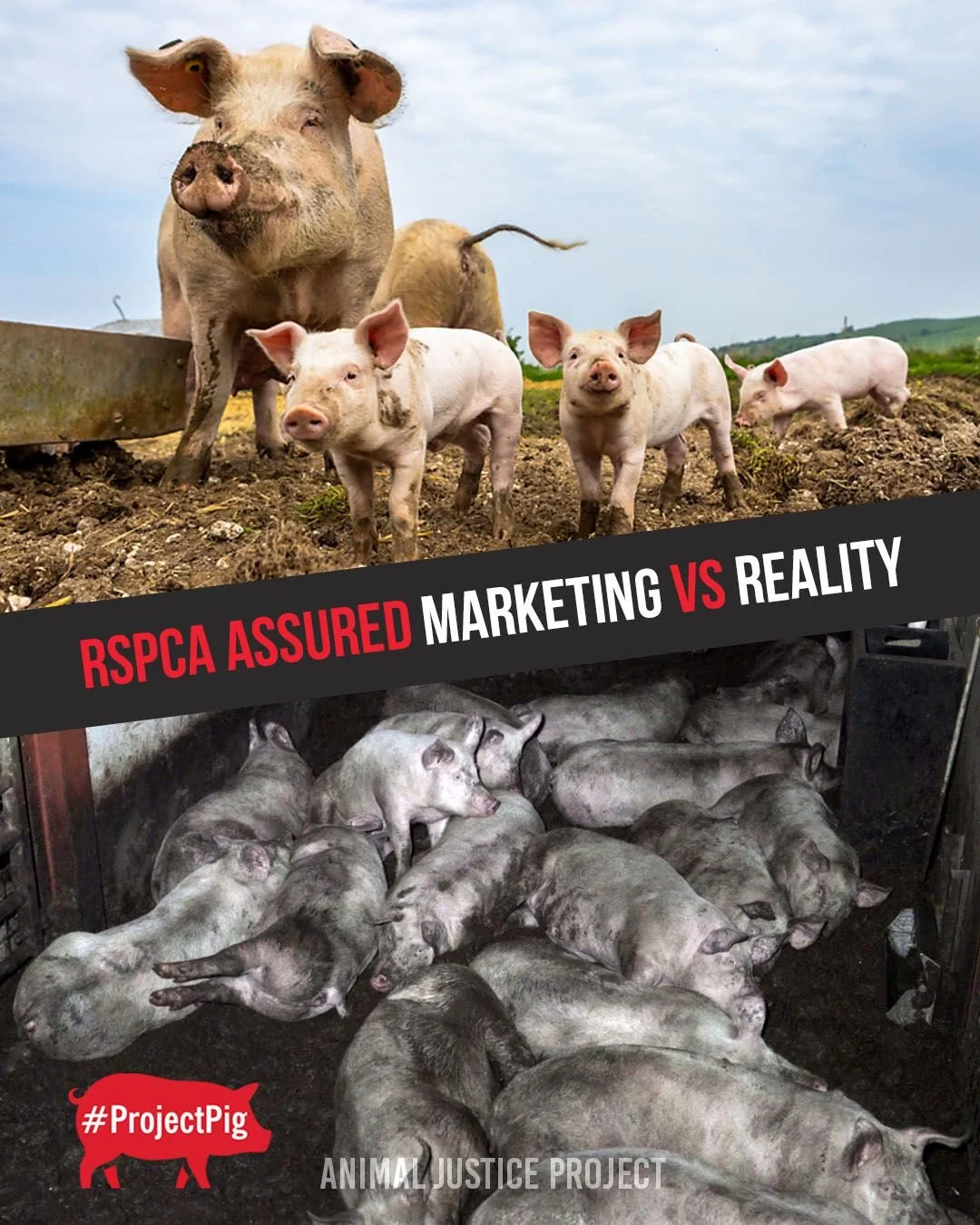
Animal Justice Project’s recent poster campaign. The pig industry is said to be “frustrated” by the images.
Finally, advocates hope that some, at least, may start to question the necessity of farming animals itself. “The function of welfare labels isn’t primarily to inform consumers,” writes Laila Kassam, founder of Project Phoenix. “It’s’ to sustain a collective story that animal exploitation is being managed responsibly, that progress is being made, that we an relax. I belive that story does serious damage to our ability to challenge the system and question its legitimacy to exist at all. Asks can be incremental, and yes, they can include welfare asks. But if those asks are embedded in a welfare story rather than a freedom story, not only will the conflict between welfare and abolitionist approaches continue, we won't be able to move society closer to animal freedom.”
“Mutilating animals like debeaking chicks and docking tails of piglets are standard industry practices, not fringe abuses,” points out Canadian vet Dr Judith Samson-French, angrily. “Most people aren’t trying to cause harm. But maybe that’s the hardest part — how easy it is to look away when suffering is built into the system, and distance is by design (try filming a kill floor). Is there a line beyond which you will not go? What are you choosing? And what are you turning away from? Really — where is your line?” [17]
Bieri, Pascal. "#Hotdog Contains No Dog." LinkedIn, 23 March 2026, www.linkedin.com/posts/pascalsbieri_hotdog-burger-peanutbutter-activity-7435630672574173185-23gU.
Plant-Based Foods Honest? Meat, Cow Muscle and EU Rules Ban Veggie…” The Guardian, 11 Mar. 2026
Bass, Claire. “Welfare Washing.” LinkedIn, March 2026,https://www.linkedin.com/posts/claire-bass-31656612_welfare-washing-truth-on-meat-labels-matters-activity-7415710263582400512-a5kP?utm_source=share&utm_medium=member_desktop&rcm=ACoAAANaw08BleR422NV93BuYJnkmGqXhs8fYQw
Cole, Matthew, and Kate Stewart. “The Distance between Us.” British Psychological Society, www.bps.org.uk
Beef, Lamb and Legumes: EU Subsidies Study.” The Guardian, 19 Feb. 2026, www.theguardian.com/environment/2026/feb/19/beef-lamb-legumes-eu-subsidies-study.
“US Dietary Guidelines.” The Guardian, 3 Feb. 2026, www.theguardian.com/environment/2026/feb/03/us-dietary-guidelines
ASPCA, “Farm Bill Moves Forward with Mixed Results for Animals, 13 March, 2026, https://www.aspca.org/news/farm-bill-moves-forward-mixed-results-animals
Farm Transparency Project, Major loss for press freedom: Federal Court grants injunction to block slaughterhouse cruelty footage, 13 Aug 2025, https://www.farmtransparency.org/media/87-major-loss-press-freedom-federal-court-grants-injunction-block-slaughterhouse-cruelty-footage
Animal Justice Project, “The Public Know Arlarming Little About Dairy”, 7 March 2025, https://www.animaljusticeproject.com/post/the-public-know-arlarmingly-little-about-dairy
Bryant Research, “Prevalence of ‘Unacceptable’ UK Farming Practices,” February 2025, https://bryantresearch.co.uk/insight-items/unacceptable-farming-practices/
Bryant Research. “UK Consumers Seek Transparent Animal Product Labels,” March 2024, https://bryantresearch.co.uk/insight-items/transparent-animal-labels/
Cutcher, Nicola. “No More Porkies.” New Humanist, 30 Jan 2024, https://newhumanist.org.uk/articles/6230
Murray, S. “Seeing animals, choosing plants: Evidence from a cafeteria field study on food choice,” Journal of Environmental Psychology, March 2026, https://www.sciencedirect.com/science/article/pii/S0272494426000897
TU Delft, “Meat shaming may reduce meat purchases,” 2 March 2023, https://www.tudelft.nl/en/2023/io/march/meat-shaming-may-reduce-meat-purchases
DEFRA, Consultation outcome: Summary of responses and government response, 12 June 2025, https://www.gov.uk/government/consultations/fairer-food-labelling/outcome/summary-of-responses-and-government-response#summary-of-consultation-responses-method-of-production-labelling
Lymbery, Phillip. “Food labelling can be confusing for ethical consumers. Here's what to do,” The Scotsman, 19 March 2026. https://www.scotsman.com/news/opinion/columnists/food-labelling-can-be-confusing-for-ethical-consumers-heres-what-to-do-6028436
Samson-French, Judith. “Think Before you Eat’, https://www.linkedin.com/posts/dr-judith-samson-french-06641a31a_thinkbeforeyoueat-questionthesystem-foodchoicesmatter-activity-7359232600827203586-_dPB?