‘Revelatory and brutal’: HIDDEN memorialises animals in the anthropocene
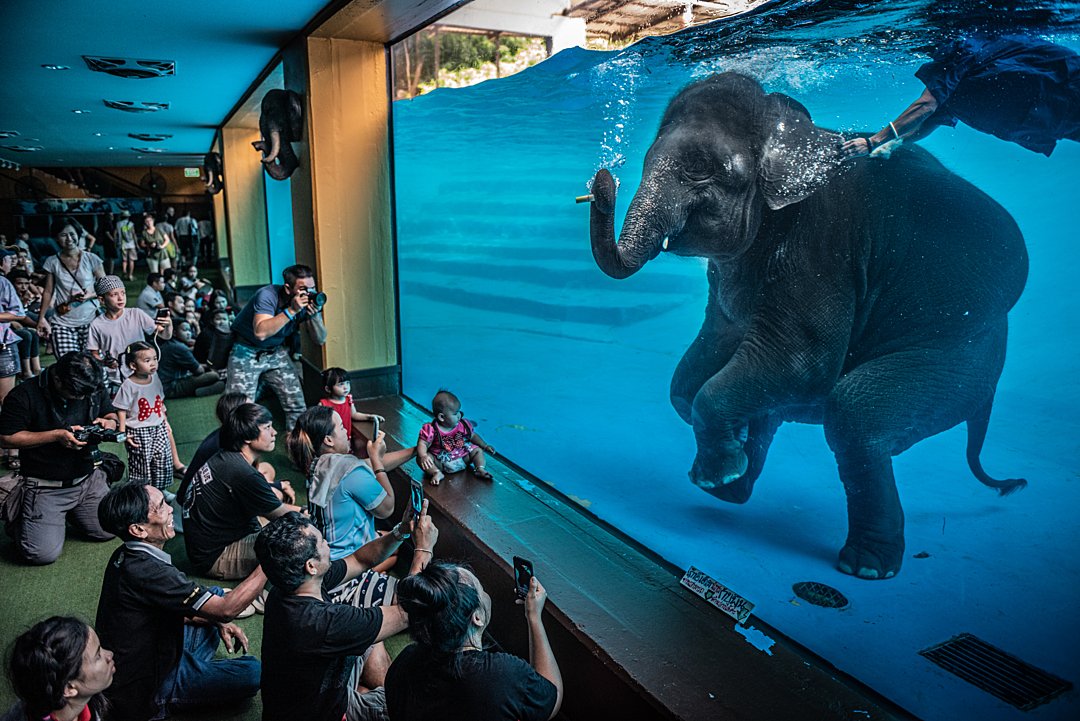
Animals as entertainment. Tourists watch an Asian elephant forced to swim underwater for performances. Khao Kiew Zoo, Thailand, 2019. Adam Oswell / HIDDEN / We Animals
Jose Valle’s photograph in HIDDEN: Animals in the Anthropocene captures an intolerable moment: dogs pressed against the walls of a slaughterhouse, some hiding their faces. In the foreground, a man, wiry and balding, drags an iron bar across the floor. One dog gazes into the lens; he is oddly serene, exhausted, nothing left to give. The caption: “A butcher chooses the dog he will beat to death.” Every time I see the picture, the same somatic distress arises; a frustrated desire to smash through time and space to pull the dogs to safety, to show them they are loved. It is a terrible, terrifying image.
Published in 2020, HIDDEN is a monumental document of humanity’s frankly savage relationship with other species. Co-edited by Jo-Anne McArthur, activist and founder of We Animals, the shots are revelatory and brutal. Across 320 pages and 204 photographs, 40 dedicated photojournalists focus on the invisible animals in our lives: the animals whose skins lie alongside our skin, whose struggles we interpret as entertainment, whose bodies sit in our bellies; whose secretions swill in our hot drinks.
Creating the book emerged from McArthur’s interest in war photography, volumes such as James Nachtwey’s legendary Inferno (1999) which deliver searing indictments of human atrocities. “Books matter because they memorialize topics that need staying power," reflected McArthur, during a trip to London. “And I decided that animals needed such a book.” Others agreed. The crowdfunder raised everything it needed in two days. For those like McArthur, who had been documenting animals for decade, it was a sign its time had come.
In reviews, the word most often used to describe HIDDEN is ‘unflinching’ - a testament to the fortitude required of its contributors, internationally recognised photographers who have travelled to the places where brutality has become routine. “I can’t sit long with the book,” I confess to McArthur over tea. “Most people say that,” she replies, evenly. And yet, HIDDEN is spectacular; its colours rich and deep, each picture immaculately framed; its subjects reverently offered. “The images are so shocking that they’re hard to put out in the world - so they had better be engaging,” she says.
It’s almost impossible to encompass the scale of animal suffering today - which is why many people don’t try. Between 80 to 100 billion, representing 60 percent of the world’s mammalian biomass, are killed for food every year. The vast majority die after wretched lives in factory farms. Billions more are used and discarded for fashion, entertainment, testing, to the illegal wildlife trade. HIDDEN is peppered with statistics but numbers are heady things. Figures such as “160 million: the global estimate of farmed animals transported to a slaughterhouse every day” only really come into focus when set alongside a scene inside a slaughterhouse truck after the cows have been unloaded. The floor is sodden with shit and urine; another world, greener, is just visible through the vehicle’s oval windows. What would the cows have seen on this, their last journey? The image thrums with lost souls. This is storytelling at its most impactful.
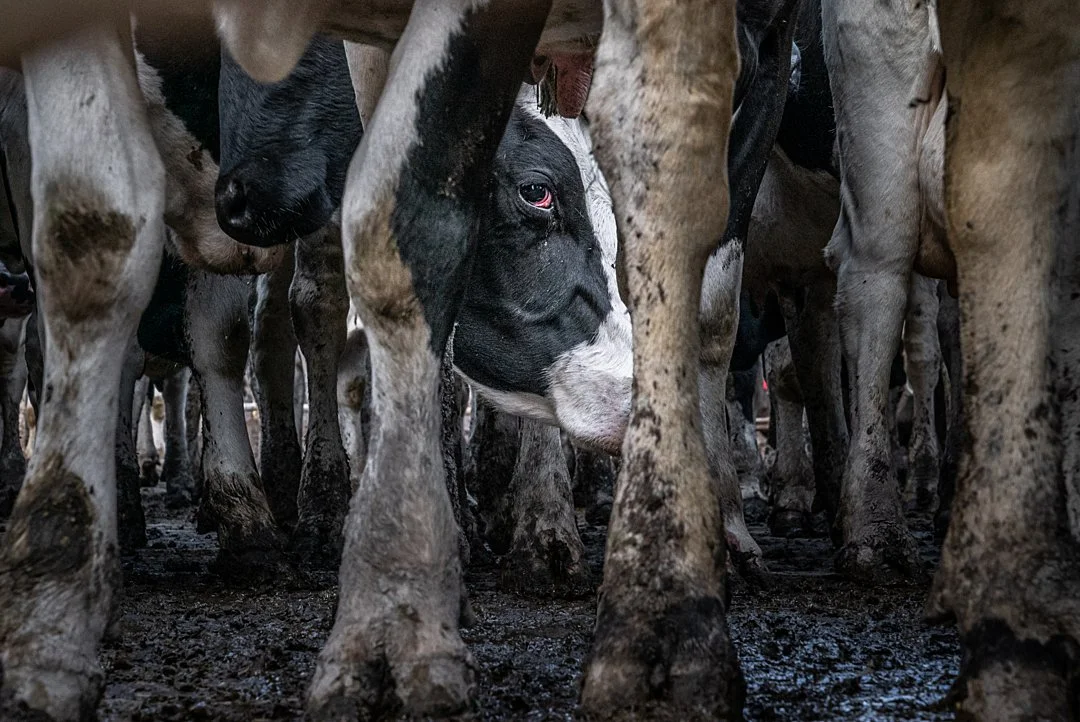
“Their gaze is full of questions for us.” Across the confines of this crowded pen, a dairy cow locks eyes with the camera. Australia, 2017. Lissy Jayne / HIDDEN / We Animals
Now just over five years old, HIDDEN has sold over 3,700 copies and has won dozens of awards, including Photography Book of the Year at the Pictures of the Year International (2020) . Its images have been used by advocacy groups and exhibited in galleries, confirming animal photojournalism (APJ) as a vital genre that exposes the lives of animals who would otherwise never get their story told, forcing transparency onto notoriously secretive industries that kill billions every year.
Through the eyes of animals
In HIDDEN, those billions become individuals. In “Why Look at Animals?, critic John Berger observed the hierachical challenge that takes place when an animal looks at a human; the exchange of the observer and the observed; the powerful and the powerless. HIDDEN’s witnesses get close to the animals and stay low, to reflect the perspective of the animals. They focus on wide eyes and bewildered faces, bringing personalities to irrefutable life, even on the edge of death. Like the dog in the slaughterhouse.
When an animal looks into the lens, “it means that they’re looking out at everyone who looks at the picture. That gaze is a confrontation, a question, requiring radical empathy and self-awareness,” McArthur once said. “Viewers must de-centre themselves and consider the world through the eyes of a different species, while holding the truth of humanity’s undeniable role in the story. When I meet animals in farms, their gaze is full of questions for us, but we don’t have a common language to communicate with them. They can’t vocalise their questions, but their gaze does it. We can’t discount that just because they are a different species.”
One of HIDDEN’S photographers Louise Jorgensen takes pictures of animals, both living and dead, in Canadian slaughterhouses. “I want others to see what I see when I look into the eyes of an animal,” she told The Guardian. “To see that there is someone equal to you looking back from behind those frightened and pleading eyes. I capture emotion in eyes to understand that animals, like us, are emotional, sentient beings with the same capacity to feel joy, love, and to suffer immensely.”
An invisible war
The parallels with war photography continue to resonate. Fundamentally, animal photojournalists are conflict photographers, says McArthur: “We go to a place of violence and document things the world needs to see.” The tolls are the same: post-traumatic stress is common, along with an additional burden, familiar to animal advocates, of being dismissed. Animal photojournalists confront humanity wth a reality it refuses to see; perhaps it’s not surprising. “I am in awe of these photographers …” writes fellow imagemaker Nick Brandt on the book’s back cover. “They are … witness to a war that so many people have little idea exists, or choose to suppress that exists. It takes enormous inner strength and bloody-minded determination to illuminate the mass extermination that unfolds every second of every day across the planet.”
“Sometimes, when I say there's a war on animals, I am being provocative,” says McArthur, keenly. “Because I want people to think about what I mean.” Most activists will know exactly. Each day, advocates’ inboxes are full of new distresses: “rabbits scream as their hair is ripped out for angora”; “help traumatised dancing bears”; “cows are often skinned and dismembered while still conscious for leather”; “247,000 sharks killed every single day.” As I write, street dogs are being massacred in India and Morocco. In January, an elderly comunity dog in Florianopolis, Brazil was tortured to death by teenagers for social media clicks. The seam of cruelty runs deep and it runs strong.

The machine churns on. A livestock export ship bound for the Middle East leaves a port with 60,000 animals on board. Australia, 2018. Gav Wheatley / HIDDEN / We Animals
Throughout HIDDEN lies a key provocation: our treatment of animals impacts us in ways most people will never realise. The largest site of industrialised suffering, animal agriculture, is now acknowledged to be a key driver of climate change and ocean acidification, of ecological disaster and species extinction, of indigenous land grabs and of global hunger; of societal breakdown and the inevitable targeting of the vulnerable. While the past five years have seen some progress - from the freefall of the fur industry to the burgeoning field of animal law - the machine churns on. A global lurch to rightwing cultures has seen companies such as KFC and Nando’s dropping their promise to the Better Chicken Commitment. In the US, the USDA is currently proposing the elimination of slaughter line speed limits, placing animals and workers at terrible risk. Cruelty has become so much part of the system that, without it, the system wouldn’t exist. “Treating animals as units of production, wringing every last penny out of their bodies, adding just one more pregnancy to a [mother]; no wonder companies want [these activities] hidden,” McArthur says. And the industry protects its own: a recent court ruling in Australia has handed copyright ofFarm Transparency Project's undercover footage to the very slaughterhouse it exposed. Meanwhile, the UK Government has just ruled testing labs as national infrastructure, making protest against them an offence.
Decreased empathy and the perpetration of violence
When humans appear in HIDDEN, they are often portrayed as victims alongside the animals they tear apart. Because, after all, who really wants to spend their days beating dogs, force-feeding geese and pinning down rabbits in laboratories? Faces are blank, focused on the job at hand. “At We Animals, we speak a lot about protecting workers. At the same time, we want readers to see that this is humanity,” says McArthur. “This is us. And we need to be able to look at ourselves.”
Her mood shifts, when speaking about activities in which cruelty is dressed up as entertainment such as rodeos and bullfighting. We talk quietly about the pre-fight injuries traditionally inflicted on the bull, from starvation to shaving his horns, before he is released into the ring to a cacophony of sound. Some bulls are so terrified they try to escape. “Afterwards, they cut their ears off and parade around with the ears in their hands,” remarks McArthur, tightly. “How much brutality can we inflict on an animal before we flinch? And the aloneness; to die that way with no help coming.”
“I once met a child who was training to be a bullfighter,” she continues. “When we asked him why, he replied: ‘Because I love bulls …’ It feels like brainwashing. There definitely needs to be more scrutiny.” The world may be waking up: three years ago, the UN Committee on the Rights of the Child officially recognized that children must be protected from all forms of violence, including violence to animals. The argument: that it led to desensitization, decreased empathy, and to the potential repeated perpetration of violent acts. If implemented, General Comment No. 26 (2023) could have an impact on every area of animal-focused entertainment and exploitation. And the young bullfighter might finally be given the opportunity to learn that love means care rather than killing.
In a searing post on Substack, social commentator Michael Corthell explores the words of Leo Tolstoy: “As long as there are slaughterhouses there will always be battlefields.” Corthell responds: “Tolstoy was not making a crude argument that every person who eats animals becomes a soldier, or that factory farming directly causes war through some simple chain of effects. His insight was deeper. He was pointing to a continuity of consciousness. When a society builds ordinary life on the organized domination and killing of the vulnerable, it does not confine that moral injury to one corner of existence. The wound spreads. The habits spread. The logic spreads.
“A civilization that becomes comfortable with slaughter does not merely tolerate one form of killing. It learns how to normalize violence, disguise it, bureaucratize it, and place it beyond ordinary moral scrutiny. That is where the slaughterhouse meets the state.”
Corthell continues: “Violence rarely survives by asking to be seen clearly. It survives by becoming ordinary. It survives by breaking moral attention into pieces small enough to bear. It survives by teaching people not to look too closely, not to ask too many questions, not to connect one form of suffering to another … The result is a public schooled in moral compartmentalization.”
Animal photojournalism refuses this ‘moral compartmentalization.” Bringing to light the hideous cruelty inflicted on animals every day “poses a fundamental threat to deeply embedded societal systems that continue, largely unchallenged,” explains McArthur. “Our existence is intertwined, and the ethics of how we treat the other sentient beings with whom we share this planet are being called into question.” HIDDEN smashes through deliberately constructed illusions that compel people to participate in systems most would otherwise reject - vehemently. And that in itself is an act of resistance. Set against entrenched forms of injustice, the work of We Animals, of HIDDEN and of its photojournalists remains more necessary than ever.